Product Lineup(For automotive use)

High performance  interlayer Films
Sound Acoustic Film
Solar Control Film
Sound and Solar Film

Standard interlayer Film

Sound insulation/Solar control interlayer Film
SSF

Environmental friendliness, comfort, and safety are three key elements called for in cars today.
In the last few years, SEKISUI has added comfort-enhancing features, such as sound insulation and solar control, to traditional interlayer films that originally increased the safety of glass. And now, the development of S-LEC SSF (Sound and Solar Film) has at last given glass the functions that contribute to all three of these main elements.
This revolutionary interlayer film, which achieves sound insulation and solar control in a single layer, can for the first time offer quietness, high fuel economy, and high impact safety in a single, laminated sheet of glass


SSF:made possible by multi-layer and fine particle technologies

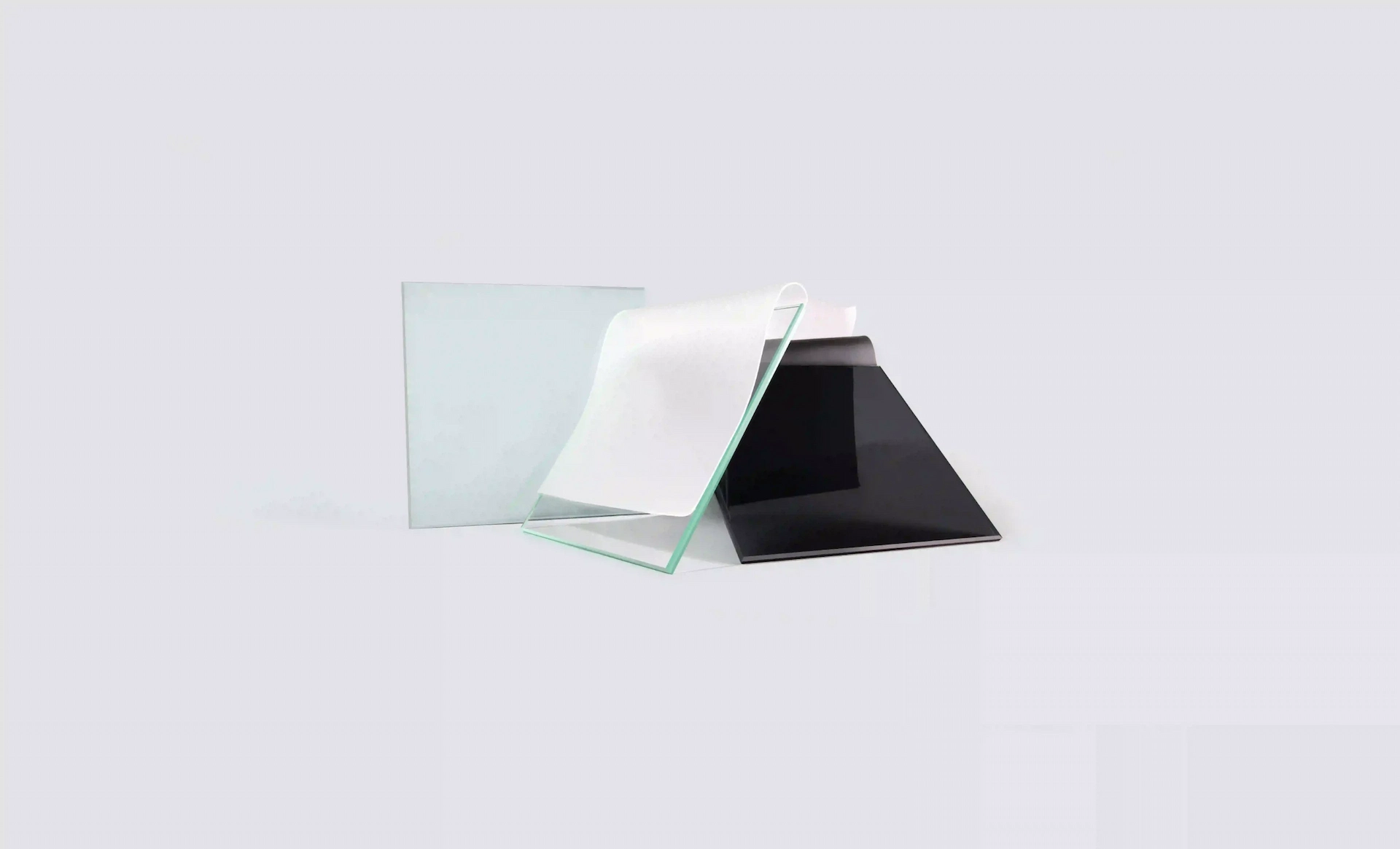
S-LEC SSF is achieved by sandwiching a sound insulation resin layer and a colored layer between PVB, and evenly distributing solar control particles on that multi-layer structure.

Now technology from Sekisui allows particles to be distributed evenly in a multi-layered, ultra-thin interlayer film.


Cut sound energy down to a third

As evident in the graph, S-LEC SSF effectively controls low-frequency vibration energy from the engine and reduces the shrilling noise of wind.

These figures show that audible noise is reduced to a third of its original loudness.


Cut heat rays from sunlight and wasteful fuel use.

Mid-infrared rays of 1,500 to 2,100 nm in wavelength result in a burning sensation on the skin, and increase cabin temperature. S-LEC SSF effectively cuts solar rays in this wavelength band. Controlling the temperature rise translates into less air conditioner use, greatly improving fuel economy.*

Radio waves across most frequency bands are not blocked, letting through mobile phone and electronic toll collection (ETC) signals, problem-free.

* Tests have shown that compact cars in a traffic jam that use air conditioning can expect an increase in fuel economy of approximately 3%.Based on materials from an academic lecture given by the Society of Automotive Engineers of Japan (jointly presented by Asahi Glass and Mitsubishi Motors)


Top of this page